
DSCR loans let California investors qualify on a property’s rental income instead of personal tax returns.
Qualify on the property’s rent — not your personal income. I’m Jason Brookes, a wholesale mortgage broker in California specializing in DSCR and investment-property loans since 2003, with aggressively low investor pricing shopped across many lenders. NMLS #1372327.
**Call or text (714) 410-2198** — I’ll price your scenario in about twenty minutes.
Table of Contents
What Is a DSCR Loan?
A DSCR loan is an investment-property mortgage that qualifies on the property’s rental income instead of your personal income — no tax returns, no W-2s, no debt-to-income ratio.
DSCR stands for Debt Service Coverage Ratio — the property’s rent divided by its monthly payment (principal, interest, taxes, insurance, and HOA). If the rent covers the payment, the property qualifies. Your tax returns, W-2s, and DTI stay out of it entirely.
That makes DSCR the workhorse loan for real estate investors: self-employed borrowers, investors with heavy write-offs, portfolios too large for conventional limits, or anyone who’d rather not document personal income at all.
DSCR loans are considered Non-QM loans
How Qualifying Actually Works
Qualifying is one calculation: the property’s monthly rent divided by its full monthly payment — at 1.0 or higher, the property qualifies on its own income.
**The ratio:** most lenders want the rent to cover the payment (a DSCR of 1.0 or higher). Stronger ratios earn better pricing. Some programs allow below 1.0 — “no-ratio” options exist at lower leverage.
**The rent:** on a purchase, the appraiser’s market-rent analysis (Form 1007) typically sets the number. On a refinance, your lease or the market rent — whichever the program uses — does the work.
**You:** credit score and reserves matter; your income and employment don’t get verified.
**The property:** 1–4 unit residentials, condos, and in many programs 5–10 unit multifamily.
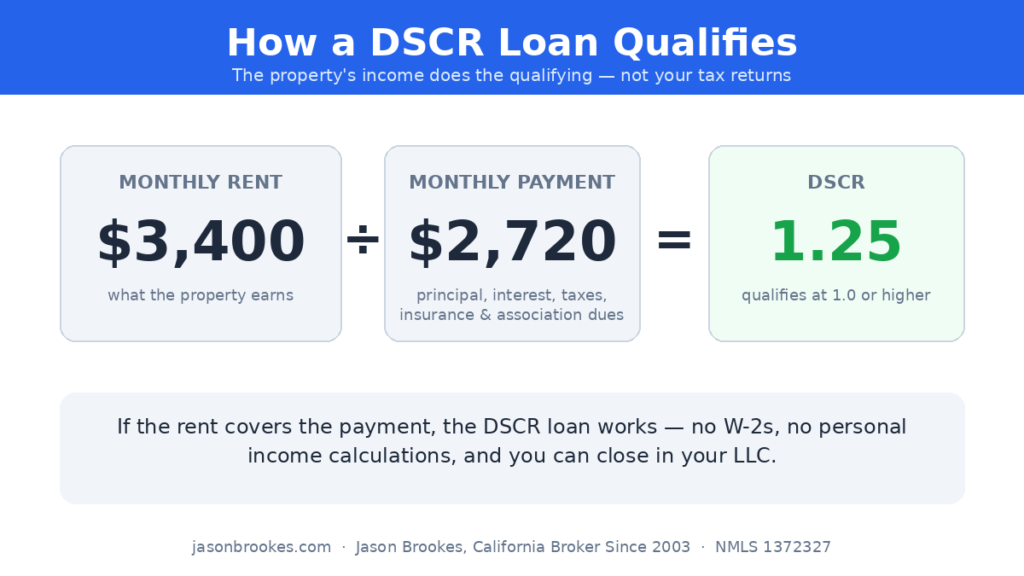
That ratio is the whole loan: a DSCR loan approves when the property’s rent covers its payment, which is why investors with heavy write-offs choose it.
DSCR Loans for Airbnb and Short-Term Rentals
Yes — DSCR loans work for Airbnb and short-term rentals: specific lenders qualify the property on market short-term rental data or your actual booking history instead of a long-term lease.
This is where lender choice actually matters, and where I spend my time. Long-term rentals are straightforward.
**Short-term rentals (Airbnb/VRBO)** and **mid-term rentals** (30+ day furnished stays — traveling nurses, insurance/ALE placements, corporate housing) are handled very differently from lender to lender: some use 12-month STR revenue statements, some cap the usable income, some misclassify the property outright.
I’ve defended STR and mid-term classifications with lenders and know which ones actually close these files — that knowledge is often the difference between the deal working at 75% LTV and not working at all.
Lenders calculate the debt service coverage ratio slightly differently for short-term rentals, and part of my job is matching your property to the investor whose DSCR loan math treats it best.
Cash-Out on Rental Portfolios
You can pull cash out of rental properties with a DSCR refinance the same way you’d buy with one — the rent covers the new payment, and your tax returns stay out of i
DSCR cash-out refinances let you pull equity from one property to buy the next without touching your personal income picture. Typical uses: down payment on the next acquisition, rehab capital, or consolidating harder-money debt into long-term financing.
What About Rates?
DSCR rates run somewhat above conventional owner-occupied rates because the loan carries investor risk — and they vary widely by lender, which is exactly why shopping one file across many DSCR investors matters.
Investor pricing is our strongest suit — it’s the main lead type I work daily, and wholesale pricing across many lenders is typically meaningfully better than what retail investor-loan shops advertise.
Rates vary with LTV, DSCR ratio, credit, and property type, so published teaser numbers mean little. Send me your scenario — address, rent, target loan amount, credit range — and I’ll return real pricing, usually the same day.
Where I Lend
I’m licensed in California plus Idaho, Illinois, Nevada, North Carolina, Oregon, Tennessee, Texas, and Utah — so California investors buying out of state can keep one broker across the whole portfolio.
California is home base (Grand Avenue Realty & Lending, CA DRE #01412977) — Orange County, Los Angeles, the Inland Empire, San Diego, and statewide.
I also hold licensing in **Nevada, Idaho, Illinois, Oregon, North Carolina, Tennessee, Texas, and Utah** through Loan Factory, Inc — which covers most of the markets California investors actually buy in.
California deals have their own wrinkles — compressed ratios, STR city rules, jumbo sizing — covered in my California DSCR loan guide.
DSCR Loan FAQ
**Do DSCR loans require tax returns or W-2s?**
No. Qualification is based on the property’s rent versus its payment, plus your credit and reserves.
**What credit score do I need?**
Programs commonly start in the 620–660 range; pricing improves meaningfully at 700+.
**What’s the minimum down payment?**
Typically 20–25% on purchases (75–80% LTV), varying with credit, ratio, and property type. Cash-out refinances usually cap around 70–75% LTV.
**Can I close in an LLC?**
Yes — most DSCR programs allow (and investors usually prefer) vesting in an LLC.
Many investors pair a DSCR loan purchase with a plan to access equity later — see every way to tap equity without touching your first mortgage.
**Do short-term rental (Airbnb) properties qualify?**
Yes, with the right lender. STR income treatment varies widely between programs — this is exactly where broker lender-knowledge pays for itself.
**Are DSCR rates higher than conventional?**
Somewhat, yes — that’s the cost of leaving your income out of the file. Wholesale pricing narrows the gap considerably versus retail investor lenders.
**How fast can a DSCR loan close?**
Often faster than conventional — no income documentation means fewer conditions. Three to four weeks is common.
Let’s Price Your Deal
Send the scenario — property, rent, loan amount, credit range — and I’ll reply personally with real numbers.
I’m an Orange County mortgage broker and DSCR loans are my core specialty — start with a quick scenario quote and I’ll shop it across my investor lineup.