
A VA loan is the strongest mortgage benefit in America — zero down, no monthly mortgage insurance, and rates the big lenders love to advertise. But the quote on a billboard is not the deal in your file, and the famous VA shops are built to capture applications, not to tell you the truth in five minutes. I’m Jason Brookes, an independent California broker since 2003, and I shop one VA file across many lenders — comparing the rate and the points behind it — then tell you straight whether your deal works, before anyone buries you in paperwork.
Table of Contents
Is the rate the big VA lenders quote actually their best deal?
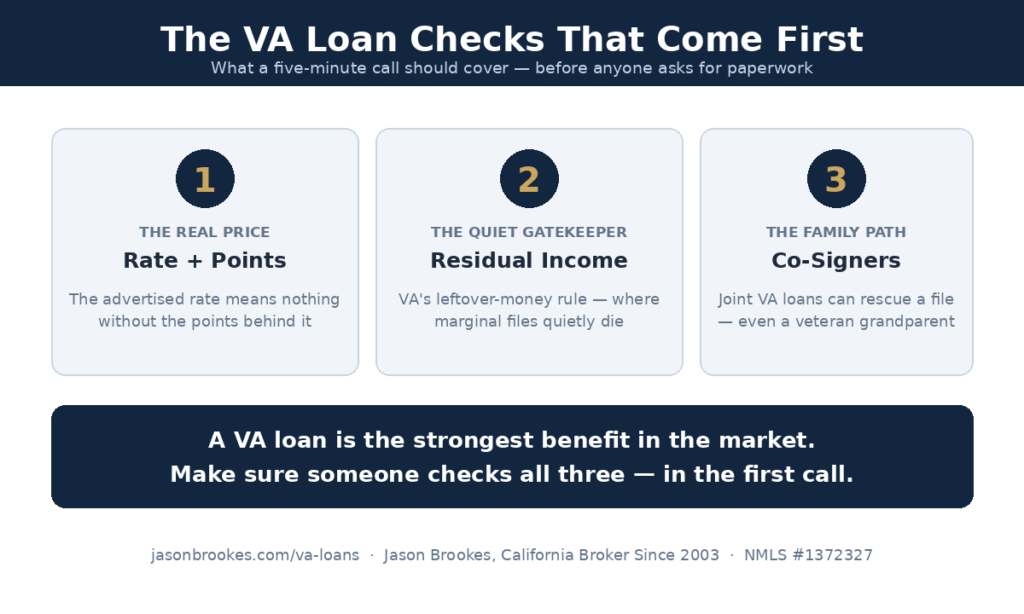
Often no — because the advertised rate frequently carries discount points that only show up deeper in the paperwork. A rate means nothing without the cost attached to it: two lenders can quote nearly the same number while one charges thousands in points and the other charges none. That’s why comparing VA offers means reading the rate and the points together — Sections A and J of a Loan Estimate — and it’s exactly the comparison I run for veterans for free. If you’re already holding a quote from Veterans United, Navy Federal, or anyone else, send it over for a second opinion — I’ll tell you the same day whether it’s fair.
A veteran called me recently — here’s how it actually goes
He was working with one of the biggest VA lenders in the country (guess the name) and thought their rate sounded good. I opened their own website with him on the phone and showed him that the advertised number carried nearly two points in cost — while I could quote him a lower rate with no points at all. That part took minutes.
But the bigger problem was one their process never told him: on a five-minute call, it was clear his residual income wasn’t enough for the loan he wanted. The big shop had already run him through a full application and a stack of document requests — the capture phase — before anyone did that basic math. I told him the truth instead: the only way this works is with a co-signer, and in his case there was a real path — his grandfather, also a veteran with VA entitlement. That’s the structure we’re pre-approving right now, before anyone wastes another hour of his life.
What is residual income — the VA rule that kills some files and rescues others?
Residual income is the money left over each month after your house payment and debts — and VA requires a minimum amount based on your family size and region, on top of the normal debt-to-income math. It’s the VA rule most borrowers have never heard of, and it’s where marginal files die late in the process. A broker who checks it in the first conversation saves you weeks; a lender who checks it after collecting your application has wasted your time. Ask about residual income on the first call — and if whoever you’re talking to can’t answer immediately, that tells you something too. It’s the quiet gatekeeper of every VA loan approval.
But residual income cuts both ways — it’s also the rule that lets VA say yes where every other loan says no. Strong residual income is VA’s official compensating factor for a high debt-to-income ratio: while conventional loans tap out near 50% DTI, I’ve structured VA approvals with ratios up around 70% because the leftover-money math was strong enough to carry them. Same rule, opposite outcome — which is exactly why it should be calculated in the first conversation, not discovered in underwriting.
Can a family member co-sign a VA loan?
Yes — and it works best when the co-signer is also a veteran with VA entitlement. VA allows joint loans, including a co-signer who won’t live in the property, but the rules are specific: when the two veterans aren’t married to each other, the loan needs VA’s prior approval, and going zero-down requires enough combined entitlement to cover VA’s guaranty requirement. This is exactly the kind of structure the call-center lenders don’t build — and it’s the difference between “sorry, you don’t qualify” and a family closing on a home. If your situation needs a co-signer — veteran or not — the right answer starts with a conversation, not an application.
Do firefighters and first responders get their overtime counted?
Yes — overtime, holiday pay, and shift differentials can all count as qualifying income when there’s a history of receiving them, typically averaged over about two years. This matters enormously for firefighters, whose base pay often tells half the story of what they actually earn. The difference between a lender who counts your real income and one who only reads the base-pay line can be the difference between qualifying and not. I work these files line by line from the pay stubs — FLSA overtime, holiday OT, specialty pays — because that’s where a firefighter’s buying power actually lives.
Honest answer: should you just use Navy Federal or Veterans United?
They’re real institutions with real strengths — familiar brands, slick apps, and sometimes genuinely competitive offers. If their deal is the best one, I’ll tell you so and you should take it. But understand what a single lender can’t do: shop your VA loan. As a broker I price one VA application across many lenders and compare the whole cost — rate, points, fees — not just the number in the ad. Sometimes the credit union wins; often it doesn’t, and the only way to know is to compare. That comparison is free, takes minutes, and comes with a straight answer either way — that’s the whole model. Since 2003, serving Orange County and all of California.
VA loan questions, answered straight
Is a VA loan really zero down?
Yes, with full entitlement and a qualifying file — no down payment and no monthly mortgage insurance, which is why VA is usually the strongest option a veteran has. No other loan type matches a VA loan on those two features.
What is the VA funding fee, and can it be waived?
It’s a one-time VA fee that can be financed into the loan — and veterans receiving VA disability compensation are typically exempt from it entirely. If you have a disability rating or a pending claim, say so early; it changes your numbers.
What’s a Certificate of Eligibility and do I need it before we talk?
The COE shows how much entitlement you have available, and no — you don’t need it before calling. Pulling it is part of my job, and I can usually retrieve it quickly with your service details.
Does getting a second opinion on my VA quote hurt my credit?
Reading your existing Loan Estimate requires no credit pull at all, and mortgage inquiries made while rate-shopping within a short window are treated as a single inquiry by the scoring models.
Jason Brookes · Grand Avenue Realty & Lending · Yorba Linda, CA · Serving Orange County and all of California since 2003 · NMLS #1372327 · CA DRE #01412977 · Equal Housing Opportunity