Table of Contents
DSCR loans in California work differently than anywhere else in the country — not because the loans change, but because California does. High purchase prices compress rent-to-payment ratios, many loans land in jumbo territory, and city-by-city short-term rental rules decide whether Airbnb income counts at all. This guide covers what actually matters for California investors, from a broker who does these loans every week. (New to DSCR entirely? Start with the full DSCR loan guide, then come back.)
Why California DSCR deals are their own animal
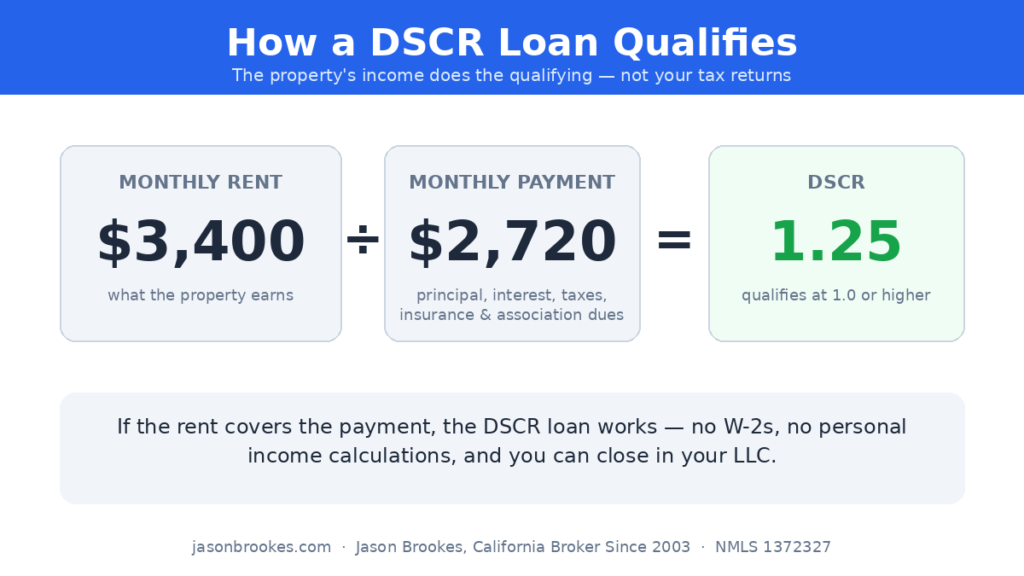
A DSCR loan qualifies on one question: does the property’s rent cover its payment? In most states, decent rentals clear that bar comfortably. In coastal California, prices are high enough relative to rents that many good properties pencil out below a 1.0 ratio — which doesn’t kill the deal, it just changes which lender can do it. Some DSCR investors accept ratios down to 0.75 with adjusted terms; others won’t touch sub-1.0 at all. Knowing which investor fits which ratio is most of the job.
California’s prices also push a large share of DSCR loans above conforming limits into jumbo DSCR territory, where the lender lineup shrinks and terms vary widely. And the state’s tenant-protection laws make lenders read California files more carefully — rent control jurisdictions, eviction timelines, and ADU income treatment all come up in underwriting here in ways they don’t in Texas or Florida.
Short-term rentals: the city decides before the lender does
For Airbnb and VRBO properties, the first underwrite is municipal. California cities range from STR-friendly (much of the desert resort market) to heavily restricted or effectively banned. Lenders know this, and DSCR loans on California short-term rentals get more scrutiny on permits and income documentation than long-term rentals do. The good news: several DSCR investors will qualify on short-term rental income — using market STR data or your actual booking history — and matching your property and city to the investor whose STR math treats it best is exactly what a broker shopping multiple lenders is for. I’ve closed DSCR loans on out-of-state short-term rentals for California investors as well; the playbook travels.
That matching problem is why DSCR loans in California reward shopping more than any other state.
Closing in your LLC
Most California investors want title in an LLC, and DSCR is the loan type built for it. Vesting in the entity, personal guarantees, and how your other financed properties count all differ by investor — another place where having one broker compare several lineups beats fitting yourself into a single lender’s box.
What a California DSCR file typically needs
No tax returns and no W-2s — that’s the point. Expect: a credit report, entity documents if closing in an LLC, purchase contract or current mortgage statement, insurance quotes (get these early — California insurance costs materially affect your ratio), and rent documentation: leases, market rent analysis from the appraisal, or short-term rental income data. Down payments generally run 20–25%, more for jumbo or sub-1.0 files. Every scenario prices differently, which is why I quote them individually rather than publishing numbers that would be wrong by Thursday.
DSCR loans in California need surprisingly little paperwork.
Why investors use a broker for DSCR loans in California
Direct DSCR lenders each have one box. California deals — compressed ratios, jumbo sizes, STR cities, ADU income, LLC vesting — frequently don’t fit the first box you try. As a broker I put one file in front of many DSCR investors and let them compete on the deal you actually have. I’m Jason Brookes with Grand Avenue Realty & Lending in Yorba Linda, a California mortgage broker since 2002, and DSCR and investment-property lending is my core specialty. Investors also use these loans to pull equity from properties they already own — cash-out DSCR refinances follow the same rent-based logic.
California DSCR questions I get every week
Can I get a DSCR loan in California if the rent doesn’t fully cover the payment?
Often, yes — DSCR loans in California frequently close below a 1.0 ratio – Down to about 0.75 — with larger down payments or adjusted terms. Coastal California deals frequently close this way. It’s a lender-matching problem, not a dead end.
Do DSCR lenders accept Airbnb income in California?
Yes — specific investors qualify on short-term rental income using market data or your booking history, provided the city allows STR operation. The city’s rules come first; then it’s about choosing the lender whose STR income math favors your property.
Can I close a California DSCR loan in my LLC?
Yes — LLC vesting is standard for DSCR loans, with a personal guarantee. Entity docs are part of the file.
Do I need tax returns or to show personal income?
No. DSCR loans qualify on the property’s rental income versus its payment. Your tax returns, W-2s, and debt-to-income ratio stay out of the file entirely — which is why investors with heavy write-offs choose them.
How many financed properties can I have?
Most DSCR investors have no limit on your total financed properties — another reason portfolio builders leave conventional lending behind.
Have a California scenario? Send it over — I’ll shop it across my DSCR investor lineup and give you a straight answer, usually the same day. Jason Brookes · Grand Avenue Realty & Lending · Yorba Linda, CA · NMLS #1372327 · CA DRE #01412977 · Equal Housing Opportunity.